New Manufacturing Innovation, New Opportunities for Leadership
A New Era of Manufacturing
Manufacturing has long been the backbone of global economic growth. For decades, however, it was defined by physical intensity, heavy machinery, and hazardous environments—conditions that created both structural and perceptual barriers to women’s participation. While this traditional base remains vital, we are now seeing new opportunities emerge with the rise of new manufacturing innovation.
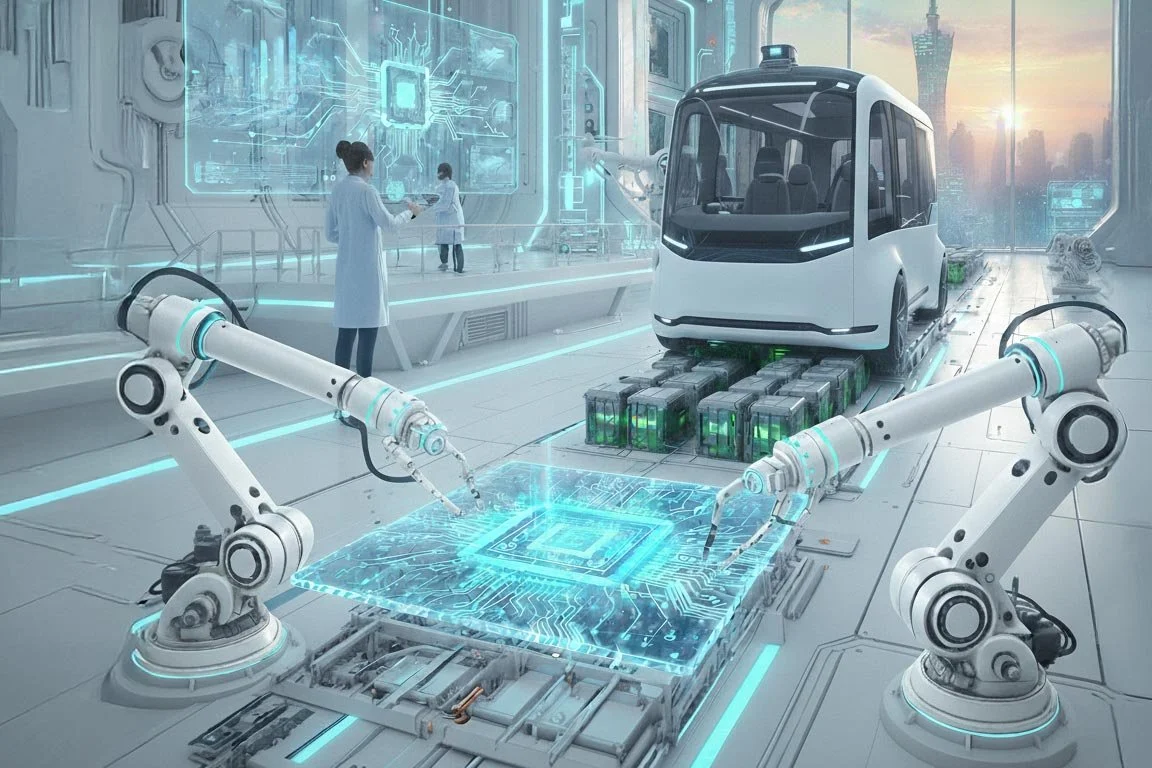
New Manufacturing generally represents a fundamental rethinking of how value is created. It refers to infusing industrial production with leading‑edge tools such as AI, automation, advanced materials, and digital design, while also changing systems, supply chains, and jobs around them. The goal is to transform manufacturing into something more productive, resilient, sustainable, and worker‑friendly. What was once considered “futuristic” is rapidly becoming the baseline requirement to compete in the modern economy.
The Asian Engine, The Hidden Superpower
When the global community discusses the future of New Manufacturing, the data suggests that the true engine of this revolution lies in Asia. Asia isn’t merely participating in this development era; it is driving it.
According to the International Federation of Robotics, the region accounted for 74% of all new industrial robot installations globally in 2024, compared with 16% in Europe and 9% in the Americas, which cemented its status as the world’s primary laboratory for automation.
The region is also dominating the global Smart Factory market with a 36% share in 2025, driven by the rapid adoption of “Industry 4.0” technologies (Coherent Market Insights).
East and Southeast Asia are central to over 80% of the world's semiconductor production, crucial for artificial intelligence advancements and global tech growth (Asian Development Blog).
More than 60% of all electric vehicles sold in the first half of 2025 happened in Asia (Liahnson & Company)
But Asia’s true leadership potential doesn’t just lie in its technology, but rather in the representation of women within its talent pipeline. Unlike many other regions still struggling to attract women to STEM fields, several Asian economies have successfully cultivated a quality female technical workforce.
Thailand and Malaysia, both emerging powerhouses in the semiconductor supply chain, have some of the highest shares of female researchers globally (ranking between 53% and 48%) (UNDP).
In Brunei, Malaysia, and Thailand, women actually dominate higher education in Natural Sciences with representation exceeding 70% (UNDP). Meanwhile, women account for only 39% of physical science degrees awarded in the U.S. (AIPRM)
China, which leads the world in AI patents and EV manufacturing, has the rate of female participation in the STEM workforce at 45.8% (CHOICE)—higher than the U.S’s 35% (National Center for Science and Engineering Statistics).
In Central Asia, in 2022, women represent 50.8% of the region’s research & development researchers, compared to 34% in North America and Western Europe (UNESCO Institute for Statistics).
It is notable that the very economies driving the New Manufacturing revolution in Asia are also the ones that have successfully cultivated the strongest female talents. By tapping into 100% of their labor forces, these Asian economies are building an inclusive and robust capacity that surpasses other regions.
The Leadership Disconnection
Despite this massive pool of female talent, a paradox emerges when we look at the decision-making level. While women are hyper-visible in universities, labs, and research centers, they remain largely invisible in the executive suite. The representation of women decreases as they advance in their professional trajectories. In the technology sector across Southeast Asia, women represent 32% of the workforce, yet they hold only 12% of Chief Technology Officer (CTO) positions. Similarly, of the approximately 30 “unicorns” (startups valued over $1 billion) in the region, only 3 are women-led.
Why does this gap persist? Part of the answer lies in a “timing lag.” The aggressive push for female STEM education in Asia is a relatively recent phenomenon, meaning many of these innovators are currently in the early-to-mid stages of their careers and have not yet had the time to ascend to C-suite roles. But more importantly, structural barriers remain. Various factors hinder women from entering and progressing in the workforce, including gender biases and stereotypes in recruitment and promotion, the sector’s highly competitive nature, inadequate work-life balance, as well as the pressure to conform to traditional gender roles. Therefore, in workplaces with fewer female role models and lower status for women on average, forming effective networks and acquiring social capital becomes more challenging for women.
GWA’s Approach
The transition to New Manufacturing offers a unique opportunity to address this imbalance. Unlike traditional manufacturing, which was often defined by physical intensity, New Manufacturing relies on cognitive adaptability, complex problem-solving, and systems thinking—areas where female leadership across the world is already excelling.
In our 2026 focus on New Manufacturing Innovation, GWA proposes to bridge the gap between technical talent and global leadership by positioning women not only as contributors, but as co-designers and leaders of the transformation. We are advocating for a global collaboration for advanced manufacturing that prioritizes inclusive leadership. While Asia-based institutions are producing female researchers at record rates, these innovators often don’t reach the executive suite. GWA emphasizes the need to clear the path from the lab to the boardroom. Through our programming, we are building a network that connects high-potential and established female figures in the field to highlight their work and support aspiring leaders.
Nominate a New Manufacturing Innovation Fellow to invest in future leaders.
Recommend a Role Model to spotlight female leaders in New Manufacturing Innovation.